THE LETTER
A class from a ratio
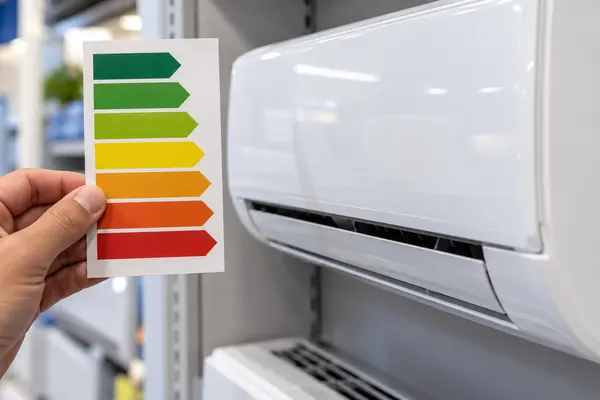
For split and wall units, the class comes from the SEER: cooling delivered over a season divided by the electricity used. A+++ needs a SEER of 8.5 or more.
Check a class bestpricesolarac
WHAT THE LABEL SAYS
Every air conditioner sold in Great Britain carries an energy label.
Check a class
kWh × RATEis the running cost
It shows a letter, a ratio and a number of kilowatt hours. Put together with the unit rate on your tariff, those figures tell you roughly what an hour, or a summer, of cooling costs to run.
At a glance
350 hours
Cooling hours assumed for the yearly kWh
The rules assume 350 equivalent hours at full design load each year for cooling. Use the unit more or less than that and your yearly kWh will differ from the label.
LABEL RULES · REG. 626/2011
26.32p/kWh
Average electricity unit rate, Direct Debit
Ofgem's cap for 1 October to 31 December 2026 averages 26.32 pence per kWh for electricity, plus a daily standing charge. Your own tariff and region may differ.
OFGEM PRICE CAP · OCT–DEC 2026
TWO NUMBERS WORTH KNOWING
One figure behind the label's yearly kWh,
one from Ofgem to turn kWh into pence.
The cap is an average across England, Scotland and Wales for standard variable tariffs paid by Direct Debit. Ofgem sets it every three months, so check the latest figure and your own bill.
WHAT DOES THE LETTER MEAN?
Pick a class from a split or wall-mounted unit's label to see the SEER range it stands for. The bar shows how much electricity the unit needs for the same amount of cooling: shorter is better.
These ranges are for air conditioners other than single- and double-duct portables, which have their own thresholds.
THE SHORT ANSWER
The label is set by regulation 626/2011, as it applies in the UK.
Here is what each figure means.
THE LETTER
For split and wall units, the class comes from the SEER: cooling delivered over a season divided by the electricity used. A+++ needs a SEER of 8.5 or more.
Check a classTHE KWH
The annual kWh on the label is worked out for a reference season of 350 full-power cooling hours, not for your house or your summer.
See the numbersPORTABLES
Single- and double-duct portable units use EER and show kWh per 60 minutes instead, on their own class scale.
Do the sum
FOUR STEPS TO A RUNNING COST
This is simple arithmetic, not a forecast: real use depends on the weather, the room and the thermostat. It helps you compare like with like.
Split and wall units show kWh per year for cooling; portable duct units show kWh per 60 minutes.
Look on your bill or tariff for pence per kWh. Ofgem's capped average for October to December 2026 is 26.32p.
kWh × pence per kWh = cost. For example, 1 kWh per 60 minutes at 26.32p is about 26p an hour.
Compare split units by SEER and portables by EER: the two have different class thresholds.
THE SMALL PRINT
The rules say the yearly kWh on a split unit's label is rounded up to the nearest whole number, and the hourly kWh on a portable is rounded up to the nearest integer too.
The label also gives the design load or rated capacity in kW: how much cooling the unit is built to deliver. Two units with the same class can use very different amounts of electricity if one is much bigger.

Questions
Seasonal energy efficiency ratio. The GB rules define it as the reference annual cooling demand divided by the annual electricity used for cooling, so a higher number means more cooling per unit of electricity.
Single- and double-duct air conditioners are labelled on their rated energy efficiency ratio (EER) and hourly energy use in kWh per 60 minutes, with their own class thresholds.
Not necessarily. It is calculated for a reference season of 350 equivalent full-load cooling hours. If you run the unit for longer or shorter, your use will differ.
The one on your own bill. As a reference, Ofgem's price cap for 1 October to 31 December 2026 averages 26.32 pence per kWh for electricity by Direct Debit, plus a standing charge.
No. The regulation sets separate class tables: for split units an A means a SEER of 5.1 to 5.6, while for single-duct units an A means an EER of 2.6 to 3.1.
Sources
ABOUT THIS NAME
bestpricesolarac.com is part of the DoodleSale portfolio. It isn't in an auction right now, but you can ask about leasing it.